




Life Coaching for Kids –
Parent Frequently Asked Questions
This FAQ is written for parents and caregivers exploring life coaching for their own children. The answers on this page are adapted from A Parent’s Guide to Life Coaching for Kids – When to Add a Coach to Your Parenting Team by Renaye Thornborrow, founder of Adventures in Wisdom and a pioneer of bringing life coaching and mindset skills training to children. .
Adventures in Wisdom developed the first story-based life coaching for kids curriculum created specifically for children in 2010 and has certified life coaches for kids since 2013. For more than a decade, our work has supported children, families, educators, and coaches in over 30 countries around the world. And we’d be honored to serve your family.
This page serves as a comprehensive parent reference guide for questions about life coaching for kids and reflects more than a decade of child-specific coaching experience and curriculum development.
On This Page
Life Coaching for Kids and Mindset Coaching
- What is life coaching for kids?
- Who created life coaching for kids?
- What is mindset coaching for children?
- How is mindset coaching different from life coaching for kids?
Coaching and Parenting
Coaching and Counseling/Therapy
- How is life coaching for kids different from counseling or therapy?
- Is life coaching for kids safe?
- When should a parent consider counseling or therapy instead of coaching?
Reasons Parents Hire a Coach – Coaching kids is Different
- When do parents consider life coaching for their child?
- How is coaching children different from coaching adults?
- What ages is life coaching for kids designed for?
Coaching Process
- What happens in a life coaching session for kids?
- How does story-based life coaching work?
- Is there a structured coaching process, or is coaching improvised?
- What skills do children learn through life coaching?
- How are skills chosen for a child?
- How long does life coaching for kids usually last?
- How are parents involved in life coaching for kids?
Choosing the Right Path
- Do life coaches for kids need specialized training?
- How do I know if life coaching is right for my child?
- My child doesn’t have a problem. Is life coaching right for my child?
- Is life coaching for kids covered by insurance?
What is life coaching for kids?
Life coaching for kids helps children develop the mindset and the skill set needed for confidence, self-esteem, resilience, self-leadership, and achievement so that they are confident and prepared to thrive in life. Coaching is an empowering process helping children understand how their thoughts influence how they feel and what they do. Through coaching stories, guided conversation, and experiential activities, children learn practical tools they can use in everyday situations at school, at home, and with peers.
Life coaching for kids is a non-clinical and skills-based approach. It supports growth, learning, and self-understanding in a way that is developmentally appropriate for children.
Just as an athletic coach helps a child build the skills, confidence, and ability to thrive in their sport, a life coach for kids helps children build the skills, confidence, and ability to thrive in life.
Teaching these skills early helps children develop skills they can use throughout childhood, in high school, and for life.
Who created life coaching for kids?
Life coaching for kids is different from life coaching for adults, and the reason comes down to brain development. This led to the creation of a child-focused story-based coaching model by Adventures in Wisdom to support children in learning, practicing, and using mindset skills long term.
Adult coaching relies heavily on asking reflective questions and guiding clients through deep personal insight. This works because adults have fully developed frontal lobes, the part of the brain responsible for critical thinking, reasoning, and self-reflection.
Children’s brains are still developing. The frontal lobe is not fully formed, which means children do not yet have the same capacity for abstract reasoning or deep self-analysis. A coaching approach that depends only on asking questions can feel confusing or frustrating for a child.
To coach children effectively, a different approach is required.
Life coaching for kids must include a teaching component that helps children understand concepts and skills in developmentally appropriate ways. Once a child understands the skill, coaches then use discovery questions and coaching techniques to help the child apply what they are learning to their own life.
This is where story-based coaching becomes essential. Stories, metaphors, and activities give children a concrete way to understand ideas that would otherwise feel abstract.
Recognizing this need, Adventures in Wisdom developed one of the first life coaching curricula designed specifically for children in 2010. The curriculum was created to align with how children learn, think, and grow, using stories, discussion, and skill-based activities rather than adult-based coaching models.
Since 2013, this child-specific approach has been used by trained coaches to support children and families around the world.
What is mindset coaching for children?
Mindset coaching for children empowers children by helping them understand the power of their mind and how their thoughts shape their feelings, behaviors, confidence, achievements, happiness, and overall life experience. Mindset coaching is a core component of life coaching for kids.
Using age-appropriate language and simple brain science concepts, children learn that:
- thoughts influence feelings
- feelings influence actions
- repeated thoughts form belief systems
- belief systems shape habits and results
As children begin to see this connection, they develop healthier self-talk, stronger emotional awareness, and more supportive belief systems that help them navigate life with greater confidence.
Mindset coaching empowers children to recognize that they are not stuck with their thoughts. They can choose thoughts that support growth, confidence, and positive action.
Mindset development is a foundational part of life coaching for kids, where these insights are combined with practical skills so children not only understand how their mind works, but also know what steps to take to build confidence and navigate real-life situations.
How is mindset coaching different from life coaching for kids?
Mindset coaching focuses on helping children understand and shape their thoughts, while life coaching for kids includes mindset development plus practical skill-building to support real-life growth and decision-making.
Mindset coaching and life coaching for kids are closely related, but they are not exactly the same.
Mindset coaching focuses specifically on how children think. It helps children understand:
- how their thoughts influence their feelings
- how repeated thoughts shape belief systems
- how belief systems impact confidence, self-esteem resilience, behavior, achievement, and happiness
Through mindset coaching, children learn that they have the power to choose supportive thoughts and develop belief systems that help them grow.
Life coaching for kids helps children develop the mindset and the skill set needed to be confident and prepared to navigate life’s challenges, reach their fullest potential and thrive in life. It combines mindset development (how children think) and skill development (what children do).
In addition to understanding their thoughts, children learn practical, step-by-step skills they can apply in everyday life. These skills may include:
- Building confidence through structured stretch activities and practice
- Strengthening self-esteem through healthy self-talk
- Overcoming worries and anxiousnessManaging peer pressure
- Achieving goals
- Managing change and moving through fear
- Bouncing back from mistakes, setbacks, and disappointment
In simple terms:
- Mindset coaching teaches children how to think.
- Life coaching for kids teaches children how to think and what to do.
Sometimes the terms mindset coaching and life coaching are used interchangeably. However, life coaching for kids is the broader framework that incorporates mindset work as well as practical life skills training.
At Adventures in Wisdom, mindset development is woven throughout a structured coaching curriculum designed specifically for children. The goal is to empower children with the thinking skills and the tools to shape their lives, goals, and dreams with confidence and clarity.
How is life coaching for kids different from parenting? Isn’t that a parent’s job?
Parents are always the most important influence in a child’s life. A life coach for kids works in partnership with parents and is part of the parent’s team of trusted advisors to help their child develop the mindset and the skill set to be confident and prepared to thrive in life.
Just as parents may hire a sports coach to develop athletic skills or a music teacher to build music skills, a life coach for kids focuses on developing mindset and life skills that influence confidence, self-esteem, resilience, decision-making, self-leadership, relationships, and goal achievement.
Life coaches for kids are trained specifically in mindset and skill development. They understand how children learn, how belief systems are formed, and how to teach these concepts in developmentally appropriate ways. Many of the mindset tools children learn through coaching are not skills most adults were explicitly taught growing up.
Coaching also provides dedicated space and time focused on skill development. Away from everyday family dynamics, children can reflect, practice, and internalize new ways of thinking.
When parents choose life coaching for their child, they are supporting their children in developing critical life skills that will support them throughout childhood, teen years, and into adulthood, helping them grow into confident, capable individuals.
How is life coaching for kids different from counseling or therapy?
Life coaching for kids is a non-clinical, skill-based approach focused on mindset development and growth, while counseling and therapy are clinical services designed to diagnose, treat, and support mental health conditions.
Life coaching for kids and counseling or therapy serve different purposes.
Life coaching for kids is designed for children who are generally functioning well but would benefit from building stronger mindset and life skills. Coaching focuses on helping children develop confidence, self-esteem, resilience, self-leadership, decision-making, and achievement skills..
Counselors and therapists, on the other hand, are licensed mental health professionals trained to assess, diagnose, and treat clinical concerns. Therapy often supports children who are experiencing significant emotional distress, trauma, depression, severe anxiety, OCDs, behavioral disorders, addiction, or crisis situations.
One helpful way to understand the difference is to think of mental health as a continuum, with mental wellness on one end and mental illness on the other.
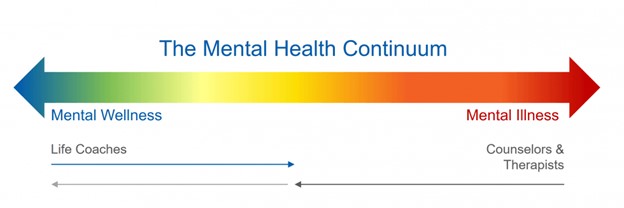
Counselors and therapists can support children across this entire continuum, particularly when a child is struggling or in crisis. Their work is essential in helping children move toward stability and healthy functioning.
Life coaching for kids focuses on the wellness side of the continuum. Coaching helps children proactively build the mindset and coping skills that support long-term mental wellness.
Through coaching, children learn to:
- Recognize and shift limiting thought patterns
- Strengthen healthy self-talk and self-esteem
- Develop resilience and emotional regulation
- Build confidence and self-belief
- Practice skills for handling everyday challenges such a changes, setbacks, and disappointments
- Learn how to make good decisions
- Develop self-leadership skills
- Learn how to manage peer pressure
- Learn to live life with direction and achieve their goals
The following overview provides additional clarity around when coaching or counseling may be appropriate based on a child’s level of need.
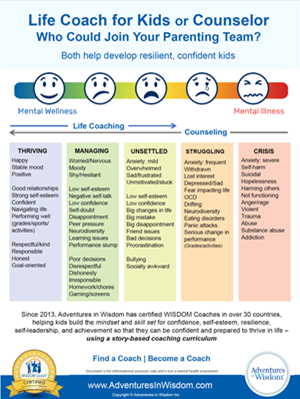
Click image to download your copy
Coaching does not diagnose or treat mental health conditions. Coaching equips children with practical tools to strengthen mindset and life skills so they can navigate challenges more effectively.
Both coaching and counseling play important roles in supporting children’s mental well-being. The right support depends on where a child is on the continuum and what type of guidance they need.
If you are unsure, starting with a licensed mental health professional for assessment can help determine whether clinical support is needed, or whether skill-based coaching would be appropriate.
Some families use life coaching alongside therapy, depending on their child’s needs.
Is life coaching for kids safe?
Yes. When delivered by a trained coach using a child-focused coaching curriculum, life coaching for kids is designed to be emotionally safe and developmentally appropriate.
Coaches use stories, metaphors, and child-friendly language to help children explore thoughts and feelings without feeling embarrassed or put on the spot. Sessions are structured, supportive, and focused on learning and skill-development.
Important: Parents are always encouraged to follow the same screening and discernment they would use when choosing anyone to work with their child.
When should a parent consider counseling or therapy instead of coaching?
Counseling or therapy may be appropriate if a child is experiencing severe anxiety, depression, trauma, self-harm behaviors, threats of harm to themselves or others, or other concerns that interfere with daily functioning.
Licensed mental health professionals are trained to assess, diagnose, and treat clinical conditions. If a child’s safety, emotional stability, or overall functioning is in question, clinical support should be the first step.
Life coaching for kids is best suited for skill-building, growth, and proactive development. Coaching does not diagnose or treat mental health conditions. A qualified life coach will remain within their scope of practice and will encourage families to seek therapeutic support when needed.
Both counseling and coaching can play important roles in supporting a child’s well-being, the key is choosing the right support for the child’s current needs.
When do parents consider life coaching for their child?
Parents often consider life coaching when they notice a decrease in confidence or self-esteem, an inability to deal with setbacks or changes, a lack of motivation or direction, struggles with friendships or peer pressure, or when they want proactive support during times of growth or transition.
Below is a reflective checklist you can use as you consider whether life coaching could benefit your child. If you are noticing any of these situations, it may be a sign that additional support from a Certified WISDOM Coach® could be helpful.
How is your child feeling?
Parents often consider coaching when they notice shifts in how their child feels about themselves or the world around them, such as:
- a drop in self-esteem or increased negative self-talk
- a loss of confidence, fear of trying new things, or giving up easily
- difficulty letting go of mistakes or a tendency to blame others
- Worries or anxiousness that interfere with enjoyment of everyday life
- frequent frustration, anger, or emotional outbursts with siblings or friends
- shyness or hesitation to participate in new activities or social situations
What is your child doing?
Coaching is also considered when parents see challenges in behavior, responsibility, or decision-making, including:
- struggles with schoolwork, assignments, or tests
- ongoing battles around chores, homework, or screen time
- concerns about honesty or sneaky behavior
- moments of disrespect toward family members or others
- difficulty resisting peer pressure or making thoughtful choices
- navigating a big change such as a move, a new school, family changes, or shifting friendships
What does your child want?
Sometimes coaching begins with a child’s own goals or interests. Parents may explore coaching when their child:
- has a big goal, such as improving grades, excelling in an activity, or making a team
- wants stronger friendships or a better sense of belonging
- is eager to learn a new skill or grow in a specific area
What do you want as a parent?
Many parents also choose life coaching because of what they value. Coaching may be a good fit if:
- you value personal development and want to proactively support your child’s mindset and self-leadership
- you want more positive dynamics and a greater sense of peace at home
- you want a trusted advisor to be part of your child’s team and your parenting team, reinforcing the values and messages you’re already teaching
Life coaching for kids is not about fixing a child. It’s about providing support, skills, and guidance during times when growth, confidence, and resilience matter most.

Every child’s journey is different. This checklist is simply a starting point.
How is coaching children different from coaching adults?
Coaching children is different from coaching adults because children’s brains are still developing, which requires a different teaching and coaching approach.
Adult coaching relies heavily on reflective questions and deep personal insight. This works because adults have fully developed frontal lobes, the part of the brain responsible for critical thinking, reasoning, and self-reflection. Adults also have more life experience to draw from when analyzing situations and making distinctions.
Children’s brains are still developing. The frontal lobe is not yet fully formed, which means children do not have the same capacity for abstract reasoning or deep self-analysis. A coaching approach that depends primarily on asking questions can feel confusing or frustrating for a child.
Because of this, coaching children must include a stronger teaching component.
Effective life coaching for kids combines:
- developmentally appropriate teaching
- stories and metaphors that make abstract ideas concrete
- guided discussion
- structured skill-building activities
- Opportunities for reflection and applying skills to their own lives
As a child is learning a concept, the coach uses discovery questions and coaching techniques to help the child apply the skill to real-life situations.
This is why child-focused, story-based coaching models were developed. Recognizing that children learn differently than adults, Adventures in Wisdom created one of the first life coaching curricula designed specifically for children in 2010. The curriculum aligns with how children think, learn, and grow, rather than adapting adult coaching methods for young minds.
Coaching children is not a simplified version of adult coaching. It is a specialized discipline designed to meet children where they are developmentally and support long-term mindset and skill growth.
What ages is life coaching for kids designed for?
Life coaching for kids is typically designed for elementary and middle school-aged children, when mindset and belief systems are actively forming.
These years are especially important because this is often when children begin experiencing more complex challenges such as comparison, peer pressure, friendship dynamics, academic expectations, competition in extracurricular activities, disappointment, and navigating mistakes.
At this stage of development, children are forming belief systems about who they are and what they are capable of. When they encounter challenges without the skills to process them effectively, it can impact their confidence and self-esteem. Many children begin to internalize setbacks, compare themselves to others, or doubt their abilities.
Life coaching for kids focuses on equipping children with mindset and life skills early, before limiting belief systems take root. When children understand how their thoughts influence their feelings and actions, they gain tools to navigate challenges more effectively, build resilience, and approach goals with greater confidence.
Some coaches may also work with older children or teens, depending on their training and experience. However, many families choose coaching during the elementary and middle school years because this is when foundational patterns of thinking and responding are being shaped.
The skills children develop during these years can influence how they approach relationships, academics, goals, and challenges for the rest of their lives.
What happens in a life coaching session for kids?
Life coaching sessions for kids are structured, engaging, and designed to help children learn and practice mindset skills and life skills in a supportive environment.
Life coaching sessions for kids combine stories, guided conversation, interactive activities, and reflection to help children understand and apply powerful mindset and life skills.
Sessions are intentionally structured so that each one builds on the last.
A typical session may include:
- a story that introduces or reinforces a key skill
- guided discussion that helps the child connect the lesson to their own experiences
- hands-on activities that bring the concept to life
- reflection on how the skill can be used in real-life situations at school, at home, or with friends
Coaching is not a lecture, and it is not corrective. Instead, sessions are designed to feel collaborative and encouraging. Children are given space to think, share, and practice new skills in a way that feels safe and empowering.
Many parents notice that their child begins using the language and tools from coaching sessions in everyday life, applying what they have learned in real-world situations.
How does story-based life coaching work?
Story-based coaching uses stories, characters, and metaphors to help children learn mindset skills and life skills in a way that aligns with how their brains develop, remember, and apply information.
Stories are one of the most effective ways for children to learn because they engage the emotional, sensory, and thinking parts of the brain at the same time.
When children hear a story, their brain is not just processing information. It is creating images, emotions, and connections. This activates multiple areas of the brain, which makes learning more meaningful and easier to remember. In simple terms, stories help information “stick.”
From a brain science perspective, memory is strengthened when learning is connected to emotion, imagery, and experience. Stories naturally do this. Rather than asking children to think abstractly or analyze themselves directly, stories give them something concrete to relate to.
Story-based coaching also creates emotional safety. Many children are uncomfortable talking directly about fears, worries, or mistakes. When a coach introduces a character who is facing a challenge, children can explore thoughts and feelings without feeling exposed or judged. This allows learning to happen without pressure.
As children connect with characters and situations, they begin to recognize similar patterns in their own lives. Coaches then use gentle discovery questions and activities to help children apply what they’ve learned from the story to real-life situations.
Because stories are memorable, coaches can later reference characters, situations, or metaphors to help children recall a skill quickly. This supports practice, reinforces learning, and helps children use their skills outside of coaching sessions.
Story-based life coaching is a deliberate, brain-aligned approach designed to support understanding, memory, emotional safety, and real-life application. It is fun, effective, and it works.
Is there a structured coaching process, or is coaching improvised?
Life coaching for kids follows a structured, step-by-step process that guides learning and skill development while remaining responsive and adaptive to a child’s real-life experiences and needs during the coaching session. .
Effective life coaching for kids is not improvised. It follows a clear and intentional coaching process designed specifically for how children learn, grow, and apply new skills.
A structured coaching process ensures that sessions build on one another, skills are introduced with purpose, and learning is reinforced over time. This structure helps children feel oriented and supported, and it helps parents feel confident that coaching is guided rather than reactive.
At the same time, structure does not mean rigidity. Children’s lives are dynamic, and new situations naturally arise. A strong coaching process allows the coach to respond to what the child is experiencing while staying aligned with the overall goals of coaching.
In child-focused life coaching, structure typically includes:
- an initial discovery process with parents to understand goals and observations
- intentional skill selection based on the child’s needs
- a consistent coaching framework that guides each session
- opportunities for reflection and real-life application
- communication with parents to support learning beyond sessions
This balance of structure and adaptability is essential. It ensures coaching is purposeful while allowing the child to bring real experiences into the learning process.
At Adventures in Wisdom, coaches are trained to follow a proven coaching framework that has been used with children for more than a decade. The process guides the work, while the coach’s role is to create a supportive environment where children can apply skills to their own lives.
For parents, a structured coaching process provides reassurance. You can trust that your child is being supported through a thoughtful journey designed to build confidence, resilience, and self-leadership over time.
What skills do children learn through life coaching?
Through life coaching, children learn practical mindset skills and life skills such as confidence, self-esteem, healthy self-talk, resilience, decision-making, self-leadership, and goal-setting.
Life coaching for kids focuses on teaching skills children can use in everyday situations. These skills help children understand themselves better, navigate challenges, and develop confidence over time.
Some of the core skills children learn through life coaching include:
- Confidence and self-belief
Children learn how to believe in themselves, try new things, and stretch outside their comfort zone without fear of failure. - Emotional awareness and regulation
Coaching helps children learn that their feelings come from their thoughts and that they have the power to choose their thoughts. By recognizing their emotions, and understanding what’s driving them, they can respond in more constructive ways. - Healthy self-talk
Children learn how the way they talk to themselves affects how they feel and what they do, and how to choose more supportive inner dialogue. - Resilience and perseverance
Life coaching teaches children how to recover from setbacks, learn from mistakes, navigate change, and keep going when things feel challenging. - Decision-making and responsibility
Children practice making thoughtful choices, understanding consequences, and taking ownership of their actions. - Managing peer pressure
Children learn how to think for themselves, recognize when they feel pressured by others, and make choices that align with their values rather than reacting to what friends or peers are doing. - Goal-setting and follow-through
Coaching helps children identify goals that matter to them and develop the skills needed to work toward those goals step by step.
Life coaching helps children apply these skills to real-life situations at school, at home, and with peers. Over time, these skills become part of how children think, feel, and respond to the world around them.
At Adventures in Wisdom, these skills are taught through a child-specific curriculum that uses stories, discussion, and activities to support understanding, practice, and long-term growth.
They are part of a structured, research-based framework that builds progressively across multiple areas of development.
The full curriculum includes 27 mindset and life skills organized into five core categories:
- MindPower™ – Understanding how the mind works
- InnerPower™ – Developing self-leadership skills, making good decisions, and standing up to peer pressure
- MePower™ – Building self-esteem and self-confidence
- DreamPower™ – Living life from a vision and achieving goals
- Slaying Dragons™ – Navigating life’s challenges such as managing fear, mistakes, failure, and change
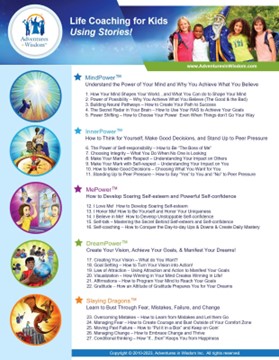
Each skill is introduced through stories, discussion, and activities designed specifically for how children learn. Coaches then help children apply these skills to real-life situations at school, at home, and with peers.
Over time, these skills become integrated into how a child thinks, responds, and makes decisions, strengthening both mindset and character.
To explore the full breakdown of each of the 27 skills, visit our detailed guide here → [Mindset Skills for Kids] Link to your long-form /mindset-skills-for-kids page.
How are skills chosen for a child?
Skill selection begins with a discovery process involving parents. Coaches learn about what parents are observing, what challenges feel most important, and what goals they have for coaching. Sometimes the child is also involved. Coaches take time to build rapport and learn what matters to the child, which helps coaching feel relevant and engaging.
Based on this information, the coach recommends an initial focus and set of skills. As coaching continues, skills may be reinforced or adjusted to reflect the child’s real-life experiences, while staying aligned with the overall goals of coaching.
How long does life coaching for kids usually last?
Life coaching for kids is typically offered in focused, short-term packages designed to support a specific area of growth.
Most life coaching programs for kids are structured into focused coaching packages, often ranging from five to eleven sessions. Each package is designed to support a specific area of development, such as building confidence, managing peer pressure, strengthening self-esteem, or navigating a transition.
Coaching is goal-oriented and intentional. Sessions build on one another, helping children learn, practice, and apply new skills over time.
Some families choose to continue coaching beyond an initial package to support additional goals or reinforce skills. Others find that a short-term program provides the clarity and momentum their child needs.
It is also common for families to re-engage with coaching at different stages as a child grows. New school years, new activities, leadership roles, friendships, and academic challenges often bring new opportunities for growth. Having a trusted coach available during these transitions can provide valuable support as children step into new responsibilities and navigate changing environments.
Because coaching focuses on skill development, many children begin applying what they learn right away — often noticing progress within the first few sessions.
How are parents involved in life coaching for kids?
Parents are involved from the very beginning through the discovery process and remain part of the coaching journey.
Coaches communicate with parents as appropriate and provide guidance on how to support skill practice at home. After each session, children receive a WISDOM for Home take-home sheet to continue the conversation and reinforce learning in everyday life.
Life coaching works alongside parenting as part of the child’s support team.
Do life coaches for kids need specialized training?
Yes. Coaching children requires specialized training because children learn and process information differently than adults.
Coaching adults and coaching children are not the same. Children’s brains are still developing, particularly the areas responsible for critical thinking, emotional regulation, and abstract reasoning. As a result, coaching methods designed for adults are not automatically appropriate for children.
Effective life coaching for kids requires the use of structured, child-focused curriculum and processes. Coaches working with children should understand how to teach mindset and life skills in ways that are engaging, developmentally aligned, and practical for young learners.
Parents are encouraged to ask coaches about:
- the curriculum or framework they use
- their experience working with children
Choosing a coach who is specifically trained to work with children helps ensure that sessions are safe, structured, and effective.
How do I know if life coaching is right for my child?
Life coaching may be a good fit if your child would benefit from learning practical skills to build confidence and self-esteem, develop self-leadership skills, navigate challenges with greater self-awareness, and learn how to achieve their goals.
Life coaching for kids is often a good fit when parents are looking for non-clinical skills-based support rather than treatment or diagnosis. It is designed to help children learn how to think, respond, and make choices more effectively as they grow.
Coaching can be especially helpful if your child is generally functioning well but could benefit from additional tools to handle emotions, transitions, social situations, or personal goals. Many parents choose coaching because they want to be proactive and give their child skills they can use long after coaching ends.
It can also be helpful to consider how your child responds to learning. Children who benefit from stories, conversation, and guided practice often engage well with life coaching.
If you’re unsure, a conversation with a qualified coach can help you explore whether life coaching aligns with your child’s needs and your family’s goals. There is no pressure to commit; the goal is simply to make an informed decision.
My child doesn’t have a problem. Is life coaching right for my child?
Life coaching for kids is not only for children who are facing challenges or problems. Life coaching for kids is a proactive way to help children build mindset skills and life skills that support confidence, resilience, and long-term success.Many parents choose coaching as a proactive investment in their child’s growth.
Helping children reach their fullest potential is about empowerment and personal development. It’s about equipping children with tools before challenges arise. Not waiting until something feels urgent.
Through life coaching, children learn skills that support them in school, friendships, extracurricular activities, and family life. They also build tools that will serve them as teenagers and adults, including confidence, emotional awareness, healthy self-talk, resilience, decision-making, and goal-achievement..
Just as families may enroll children in sports, music lessons, or tutoring to help them grow and excel, life coaching strengthens the internal skills that influence how children approach every area of life.
The skills children develop through coaching become tools they can use throughout childhood, their teen years, and into adulthood.
Is life coaching for kids covered by insurance?
In most cases, life coaching for kids is not covered by insurance because it is a nonclinical, skill-based service rather than medical or mental health treatment.
Insurance plans in the United States are designed to cover medical services, including physical health care and mental health treatment. These services typically involve diagnosis, assessment, or clinical treatment of a medical condition.
Life coaching for kids is different.
Life coaching is nonclinical and does not involve diagnosing, treating, or assessing mental health conditions. Instead, it focuses on personal development, mindset growth, and skill-building. Because it is not considered medical treatment, it is generally not covered by insurance.
For this reason, most families self-pay for life coaching services.
Some employers offer wellness benefits, professional development stipends, or flexible spending programs that may be applied toward coaching services. Parents may wish to explore whether their employer provides any form of wellness or personal development funding.
Many families view life coaching as an investment in their child’s long-term growth, similar to tutoring, sports training, or music lessons, supporting skills that can benefit their child for years to come.
How do I find a life coach for my child?
Parents can find a qualified life coach for their child through a certified coach directory or by using a guided matching process to connect with coaches who fit their child’s needs.
Finding the right coach begins with identifying someone who is trained to work specifically with children and uses a structured, child-focused coaching approach.
Parents can explore our directory of certified WISDOM Coaches® to see if there is a coach in their local area. Many coaches also work virtually online, allowing families to access support regardless of location.
If you would prefer guidance in finding the right fit, you can complete our “Connect with a Coach” form. Based on your child’s age, goals, and specific needs, we will introduce you to one or more coaches who align with what you are looking for.
From there, you can speak directly with those coaches to learn more about their style, experience, and approach. Choosing a coach is a collaborative decision, and the discovery conversation helps ensure that both you and your child feel comfortable and confident moving forward.
You can browse our Certified WISDOM Coach® directory or complete our Connect with a Coach form here to be introduced to coaches who align with your child’s needs → [Find a Life Coach for Your Child]
What is the next step if I want to learn more?
If you’d like to continue learning, you may want to explore:
- What Is Life Coaching for Kids
- Why Story-Based Coaching Works for Kids
- A Sample Coaching Journey
- What to Look for in a Life Coach for Kids
You can also choose to speak directly with a coach to ask questions and discuss your child’s situation.
At Adventures in Wisdom, parents are supported in making informed, thoughtful decisions for their families.
Adventures in Wisdom at a Glance
- Developed one of the first story-based life coaching curricula designed specifically for children — The Adventures in Wisdom® Life Coaching for Kids Curriculum (2010)
- Certifying child life coaches, known as WISDOM Coaches®, since 2013
- Certified coaches in over 30 countries
- Supporting children, families, educators, and professionals worldwide
- Creator of A Parent’s Guide to Life Coaching for Kids: When to Add a Coach to Your Parenting Team