





Emotional intelligence in children begins with one powerful truth: our thoughts create our emotions. When children understand how their thinking shapes what they feel and how they respond, they gain the foundation for confidence, resilience, empathy, and healthier choices.
Most children are never taught this, and that’s why mindset training and life coaching for kids is so important – helping children develop the mindset skills and emotional intelligence needed to be confident and prepared to thrive in life.
At Adventures in Wisdom®, our story-based life coaching for kids curriculum teaches children how their mind works. Children learn how to shift their thoughts so they can manage emotions, navigate challenges, and build stronger relationships.
Through engaging coaching stories and activities, Certified WISDOM Coaches® help children identify their thoughts, understand the feelings those thoughts create, and practice choosing more empowering thoughts that lead to calmer bodies, clearer decisions, and better outcomes.
Stories give children a safe, relatable way to explore emotions while practicing essential mindset skills such as self-awareness, self-regulation, empathy, positive self-talk, and resilience.
It’s emotional intelligence taught in a way children understand and use!
Let’s dive into what emotional intelligence really is, why the thoughts → feelings → actions connection is key, how story-based mindset coaching helps children build emotional intelligence for life, and how you can foster this in the children in your life.
[ez-toc]
What Is Emotional Intelligence in Children?
Emotional intelligence is a child’s ability to understand their feelings, manage their reactions, empathize with others, and make choices that reflect their values. At its core, emotional intelligence begins with one crucial skill: recognizing how thoughts create emotions, and that is the key behind mindset skills training. When children understand the connection between thoughts → feelings → actions, they can respond to challenges with more calm, clarity, and confidence.
Experts generally agree that emotional intelligence includes four core components:*
- Self-awareness: Noticing thoughts, feelings, and physical signals in the body.
- Self-management: Managing emotions, calming the body, and choosing helpful responses.
- Social awareness: Understanding others’ feelings and perspectives while treating themselves and others with respect and kindness.
- Relationship skills & responsible decision-making: Communicating, problem-solving, and making choices that support well-being.
These skills help children navigate friendships, communicate clearly, handle setbacks, and express themselves in healthy, confident ways.
Emotional intelligence is not fixed. It develops over time and can be intentionally taught. One of the most effective ways to nurture emotional intelligence is through stories. Stories give children a safe, engaging way to explore emotions, see different perspectives, and practice new ways of thinking. When combined with mindset skills training and life coaching for kids, stories help children build emotional intelligence from the inside out.
*Daniel Goleman, Emotional Intelligence (1995). CASEL, “SEL Framework: Core Competencies,” CASEL.org.
Why Emotional Intelligence Matters for Kids in 2025
Children are growing up in a world with more pressure, more stimulation, and more emotional complexity than ever before. As families and schools move from crisis response to prevention, emotional intelligence is now recognized as one of the strongest predictors of a child’s long-term mental, social, and academic well-being.
Children who can understand their thoughts, manage big feelings, empathize with others, and make thoughtful decisions are better equipped to handle stress, build friendships, and bounce back from challenges. These are the very mindset skills that help children thrive.
The 2025 Shift: From Emotional Strain to Emotional Skill Building
During the last several years, children who fell behind during the pandemic years have experienced heightened anxiety, social struggles, and emotional overwhelm. But new data shows a positive turn: organizations are investing in emotional skill development earlier and with greater intention.
Recent research highlights this pivot:
Emotion science is advancing. In 2024, the Yale Center for Emotional Intelligence published multiple peer-reviewed studies supporting emotion-science as a foundation for social and academic success (Yale, 2024).
SEL programs are showing strong, consistent results. A 2024 global review of 38 SEL programs found strong outcomes in emotional awareness, regulation, and resilience building
Some schools are prioritizing emotional well-being. 63% of U.S. public schools now offer some form of social-emotional learning (SEL) programs, with 72% reporting improvements in student well-being (KFF, 2024).
Why This Matters for Families
Even with growing support in schools, most children still need additional guidance to learn how their thoughts create their emotions. Emotional intelligence is not a one-time lesson. It is a skill set developed through practice, modeling, and meaningful conversations.
Children with strong emotional intelligence are more confident, resilient, and socially connected. They are better able to handle setbacks and communicate their needs effectively.
This is where story-based life coaching for kids and mindset training play a transformative role.
The Thoughts → Feelings → Actions Connection: The Foundation of Emotional Intelligence
At the heart of emotional intelligence is a powerful truth that every child needs to understand: our thoughts create our feelings, and our feelings influence our actions. This simple idea is the foundation of self-awareness, emotional regulation, resilience, and confident decision-making.
Most children grow up believing that events or other people make them feel a certain way: “She made me mad,” “The test made me scared,” “They made me feel left out.”
Emotional intelligence begins when children learn something different:
It isn’t the situation that creates their emotion.
It’s the thought they have about the situation that creates their emotion.
This is the core of life coaching for kids and mindset skills training. Helping children understand how their mind works and that they have a choice as to how they experience themselves and the situations in their lives.
For example, if a child thinks, “No one wants to play with me,” they will feel sad, anxious, and may avoid joining a game.
But if they shift the thought to, “I can ask someone to play,” they feel more confident and are more likely to take positive action.
Same situation. Different thoughts → Different feelings → Different actions.
Understanding this connection is not intuitive for most children. That’s why story-based coaching is so powerful. Stories give kids a safe and relatable way to see how thoughts shape feelings and behavior without feeling lectured or corrected.
How Does Story-based Coaching Help Children Develop Emotional Intelligence
In the earlier section, we defined emotional intelligence as a child’s ability to understand their feelings, manage their reactions, empathize with others, and make choices aligned with their values. All grounded in recognizing how thoughts create feelings, and feelings influence actions.
The Adventures in Wisdom® Life Coaching for Kids Curriculum brings these components to life. Through stories, activities, and coaching conversations, children learn emotional intelligence as a set of mindset skills they can use every day. Each of the four core components of emotional intelligence is built into the curriculum in an age-appropriate and highly practical way.
1. Self-Awareness (Understanding Thoughts, Feelings, and Beliefs)
Emotional intelligence starts with recognizing what’s happening on the inside. Adventures in Wisdom® helps children:
- Identify emotions in their body (“grungy feelings”) and name what they are experiencing
- Notice their thoughts and understand how those thoughts shape their feelings
- Become aware of the beliefs driving their reactions
- Choose thoughts that support them in moving forward, empowered (“power shifting”)
The coaching stories teach children how their mind works and make the Thoughts → Feelings → Actions connection easy to understand. With guidance from a Certified WISDOM Coach®, children learn to spot negative or unhelpful thoughts, shift those thoughts, and begin practicing more empowering ones.
This is foundational self-awareness.
2. Self-Management (Regulating Emotions and Behaviors)
Once children understand their inner experience, they can learn how to navigate it. The curriculum teaches concrete skills for:
- Managing fear and calming the body
- Handling mistakes with confidence
- Bouncing back from setbacks
- Pausing before reacting
- Choosing responses that support their goals
These are the emotional regulation skills every child needs. Through stories, reflection, and coaching, kids practice shifting from automatic reactions to intentional responses.
3. Social Awareness (Empathy and Understanding Others)
Emotional intelligence expands when children can recognize feelings, not just in themselves but in others as well. Adventures in Wisdom® helps children develop empathy through:
- Stories that show diverse perspectives
- Characters who model kindness, respect, integrity, and courage
- Guided discussions that explore motives, emotions, and choices
4. Relationship Skills and Responsible Decision-Making
The curriculum strengthens the skills children use to navigate their world:
- Clear communication
- Decision-making
- Goal-setting
- Understanding consequences
- Handling peer pressure
Children learn how to make thoughtful choices and build healthier relationships at home, at school, and with peers.
What makes the Adventures in Wisdom® approach so powerful is that children don’t just hear about emotional intelligence; they practice it. Story-based coaching makes mindset skills real, relatable, and easy to use. Kids walk away with tools they can apply immediately.
Why Stories Work So Well in Helping Children Develop Emotional Intelligence?
Stories are one of the most powerful tools for teaching emotional intelligence. They help children understand emotions not just by describing them, but by allowing kids to see, hear, and feel what characters go through. This creates connection, reflection, and long-term learning.
Why Stories Work So Well for Teaching Emotional Skills
| Benefit | Why It Matters |
| Activates the Whole Brain | Stories engage both the logic and emotion centers in the brain, creating deeper learning. |
| Creates Emotional Safety | Children explore feelings through characters, which reduces self-consciousness and opens space for discussion. |
| Sparks Meaningful Conversations | Characters’ challenges help kids talk about their own experiences in a natural way. |
| Models Healthy Problem-Solving | Kids see how the characters in the stories learn new skills to navigate emotional situations. Seeing the skills in action helps children learn the skills as well and visualize their own success. |
| Makes Learning Fun and Memorable | Stories help create a fun and engaging learning environment. Children love stories and are more likely to remember lessons learned through them. |
Example from the WISDOM Coaching Curriculum
One popular story, Canville and Cantville – a Tale of Two Towns, teaches children the impact of having an “I can” mindset versus an “I can’t” mindset. After reading the story, a WISDOM Coach® might ask, “What would this look like if you were in Canville?” This simple coaching question brings the mindset skill back into focus in a playful and powerful way.
Through stories like this, emotional intelligence becomes something kids can understand and use in everyday life.
How WISDOM Coaches Use Stories to Build Emotional Intelligence
WISDOM Coaches use a proven story-based coaching curriculum and STORY Coaching Process to help children build emotional intelligence in a way that is fun, engaging, and lasting.
This process brings mindset skills to life through stories, reflection, and hands-on learning, all tailored to how kids naturally learn.
What Is the STORY Coaching Process?
The STORY Coaching process is incredibly powerful because of its simplicity. There is a coaching tool for each step that guides a coach’s work with children. STORY is an acronym for the 5-step coaching process.
- S – Share the Story
A relatable coaching story introduces a key mindset or emotional skill in a way that feels safe and engaging. - T – Talk About the Story
Open-ended questions help children to reflect on the story and connect it to their own thoughts, feelings, and experiences under the guidance of their coach. - O – Organize an Activity
Coaches reinforce the skill through a hands-on activity such as art projects, role-play, or creative movement. - R – Review with Parent
Parents receive a brief overview of the lesson, so they can help reinforce the learning at home. - Y – Yes! Confirm Learning
Children demonstrate understanding by summarizing the skill and sharing how they will apply it in real life.
The STORY Coaching Process is what makes WISDOM Coaching so powerful. It transforms story time into skill time, giving children the emotional intelligence tools they need to thrive.
How Story-based Coaching Helped Real Kids Develop Emotional Intelligence
Hannah (Age 7): Learning to Respond Instead of React
At age 7, Hannah often shouted at her siblings and said things like “I hate you” when upset. Her frustration created constant tension at home. After working with WISDOM Coach® Sharon, she began learning how to name her feelings, calm herself, and choose more thoughtful responses. The change did not come from discipline. It came from learning how to manage emotions with tools that made sense to her.
Tina (Age 11): Turning Insight Into Action
Tina, age 11, had been in therapy for years but still struggled with anxiety and emotional regulation. Her Mom decided to add WISDOM Coaching as a complementary approach to help her daughter. Through story-based lessons and mindset tools, Tina learned how to reframe negative thoughts, speak up for herself, and feel more in control. The coaching helped her turn insight into action and reinforced the growth she was already working on in therapy.
Michael (Age 10) Turning Anger into Happier Feelings
Michael experienced frequent bouts of anger. Teachers also reported that Mike seemed depressed at school and was distancing himself from other children. He often fought with his brothers, which left his Mom feeling upset with her son and feeling helpless as a parent. Mike’s parents were stressed, and the family was on edge.
Michael worked with a Certified WISDOM Coach® and developed mindset skills to support his emotional intelligence. With positive self-talk, Michael learned to shift his anger.
He shared, “I discovered that I am in control of my feelings ─ not anyone else. This makes me feel in control of myself. How I talk to myself and think about myself is up to me. If I think bad things about myself, I feel bad about myself. If I think nice things about myself, I can shift my anger and feel happier.”
Michael is now a thriving high schooler. Read Michael’s story here.
Julie (Age 9): Bringing Emotional Intelligence to Her Whole Family
Julie had struggled in her relationships with friends and family, and she put herself down with negative self-talk. This behavior had a detrimental impact on Julie’s self-esteem and self-confidence. Julie worked with WISDOM Coach® Lisa and learned how to be kind and respectful towards herself and to others. The coaching was so impactful that Julie taught her whole family a coaching exercise that increased the emotional intelligence of the entire family – helping everyone learn how to increase respect and kindness towards others.
Why These Success Stories Matter
These success stories reflect what is possible when emotional intelligence is taught with intention. Through Adventures in Wisdom®, many thousands of children around the world have learned how to understand emotions, build resilience, and develop confidence, not just in theory, but in real life.
Want to explore more real-world results?
Visit AdventuresinWisdom.com/success-stories to see how coaching is helping kids thrive.
How Can Parents Help Build Emotional Intelligence at Home?
If you’re wondering how to help your child develop emotional intelligence at home, you’re not alone. Many parents are looking for simple, practical ways to teach emotional awareness, resilience, empathy, and healthy decision-making in everyday life.
The good news is that emotional intelligence can grow with consistent practice, and small, intentional actions go a long way. Here are four strategies you can start using right away.
1. Ask open-ended questions that spark emotional reflection.
Questions like:
- “What happened today that made you feel proud?”
- “What was the hardest part of your day, and how did you handle it?”
- “What’s a feeling you had today that surprised you?”
These questions help children tune into their feelings, recognize emotions, and practice self-awareness.
2. Use emotional language in your own daily conversations
Children learn emotional intelligence by hearing and seeing it modeled.
Try using statements like:
- “I’m feeling a little overwhelmed, so I’m going to take a deep breath.”
- “I’m disappointed about that, but I know I’ll be OK.”
- “I’m choosing to think about this in a different way.”
These statements normalize emotional expression and teach children that feelings are manageable, not scary or shameful.
3. Help your child practice seeing situations from another perspective
Try asking:
- “If your friend felt this way, what would you say to them?”
- “What do you think the other person might have been feeling?”
- “If this happened to you, how do you think you would feel?”
These questions help children learn skills for compassion and empathy.
4. Invite a Certified WISDOM Coach® to Join Your Child’s Growth Team
Sometimes children need additional support, and that’s where a Certified WISDOM Coach® can help! WISDOM Coaches join your “parenting team, ” helping your child develop these mindset skills at a deeper level.
A WISDOM Coach® helps your child:
- Understand how thoughts create feelings
- Build tools for managing emotions
- Strengthen confidence and resilience
- Navigate friendships and social situations
- Practice empathy, problem-solving, and decision-making
- Learn how to bounce back from disappointment
- Apply emotional intelligence skills in real-life situations
Because WISDOM Coaches use the Adventures in Wisdom® story-based curriculum, children learn emotional intelligence through engaging stories, relatable characters, and hands-on activities. Coaching sessions are fun, emotionally safe, and empowering.
Parents love having a partner in nurturing their child’s emotional well-being.
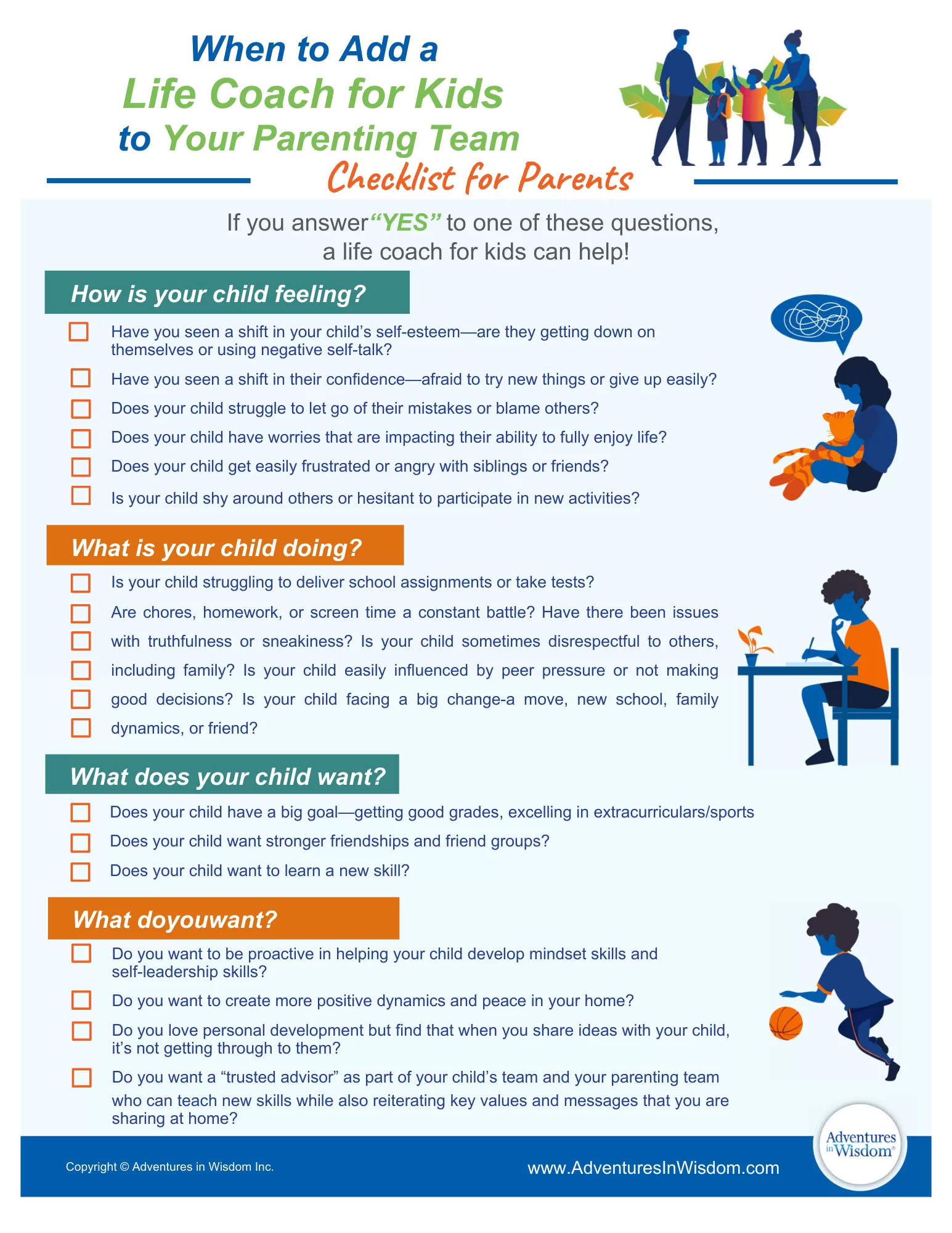
If you’d like to explore if adding a coach to your parenting team would work for your family, GRAB YOUR FREE CHECKLIST HERE.
FAQ’s About Building Emotional Intelligence in Children
What is emotional intelligence in children and why is it important?
Emotional intelligence in children is their ability to recognize their own feelings, understand others’ emotions, and respond thoughtfully instead of reacting impulsively.
Kids who develop this skill are more likely to build healthy friendships, make better decisions under pressure, and bounce back from challenges with resilience. Emotional intelligence also supports overall well-being, academic success, and social confidence.
At what age should a child start learning emotional intelligence skills?
Children can begin learning basic emotional awareness as early as age three. At that age, they can start identifying and naming simple emotions like happy, sad, or angry.
By elementary school, they are ready for more advanced skills such as empathy, emotional regulation, and perspective-taking. Structured programs for ages six to twelve are especially effective.
Can emotional intelligence be taught, or is it something a child is born with?
Emotional intelligence is not fixed. It can be taught, modeled, and strengthened through consistent practice.
Skills like self-awareness, empathy, and self-regulation develop over time with the right tools and guidance. Story-based coaching is one of the most effective and engaging ways to help children learn these skills in real life.
What benefits can children gain from strong emotional intelligence?
Children with strong emotional intelligence tend to form better relationships with peers and family. They communicate clearly, manage stress, and respond to challenges in healthy ways.
These skills also support focus, cooperation, and responsible decision-making, which are essential for success in school and life.
Can parents help their child develop emotional intelligence at home?
Yes. Parents are key in helping children build emotional intelligence through modeling, conversations, and daily experiences.
Using emotional language, validating feelings, reading stories, and practicing empathy at home all support emotional development. These everyday actions build a strong foundation for confidence and resilience.
How is social-emotional learning (SEL) related to emotional intelligence?
Social-emotional learning, or SEL, is the structured teaching of emotional and social skills in school settings.
It focuses on building self-awareness, self-management, empathy, and relationship skills. SEL programs support the same goals as emotional intelligence and have been shown to improve behavior, wellbeing, and academic outcomes for students.
How You Can Help Children Build Emotional Intelligence as a Certified WISDOM Coach®
Do you want to help children develop mindset skills for emotional intelligence?
Explore becoming a Certified WISDOM Coach® and bring this transformational work to your home and beyond. Coaches work with children in their own community and even around the world when they coach children online.
Get started today by:
- Download your free coaching story
- Explore how WISDOM Coaching® can support your child
- Learn more about how to become a Certified WISDOM Coach® if you feel called to help other children as well
Renaye Thornborrow is leading a worldwide mission to bring life coaching to kids. Since 2013, Adventures in Wisdom® has certified hundreds of coaches in over 30 countries, helping them create a business they love as a life coach for kids, while helping children build the mindset and skill set for resilience, self-esteem, achievement, and self-leadership so that they are confident and prepared to thrive in life.
*** The end ***
Adventure well, my friend!
Copyright (C) 2011-2025 Adventures in Wisdom®, Inc. All Rights Reserved.